

Overview: Asian Movement Version / Swiss Movement Version / 1:1 Clone Version
The replica market is mainly divided into three tiers. The difference is not just "how close it looks," but movement architecture, steel grade, crystal optics, whether complications actually work, plus lifespan and serviceability.
Asian Movement Version
2813-grade platform, standard 316L, basic synthetic sapphire, decorative chronograph subdials only. For budget-first, occasional wear.
Swiss Movement Version
2824 / 2836 high-beat platform, 317L high-moly steel, optical synthetic sapphire, colorless AR. For daily wear and value seekers.
1:1 Clone Version
Integrated custom caliber, high-purity 904L superalloy, CNC micro-beveled finishing, fully functional chronograph subdials. For collectors and ultimate pursuit.
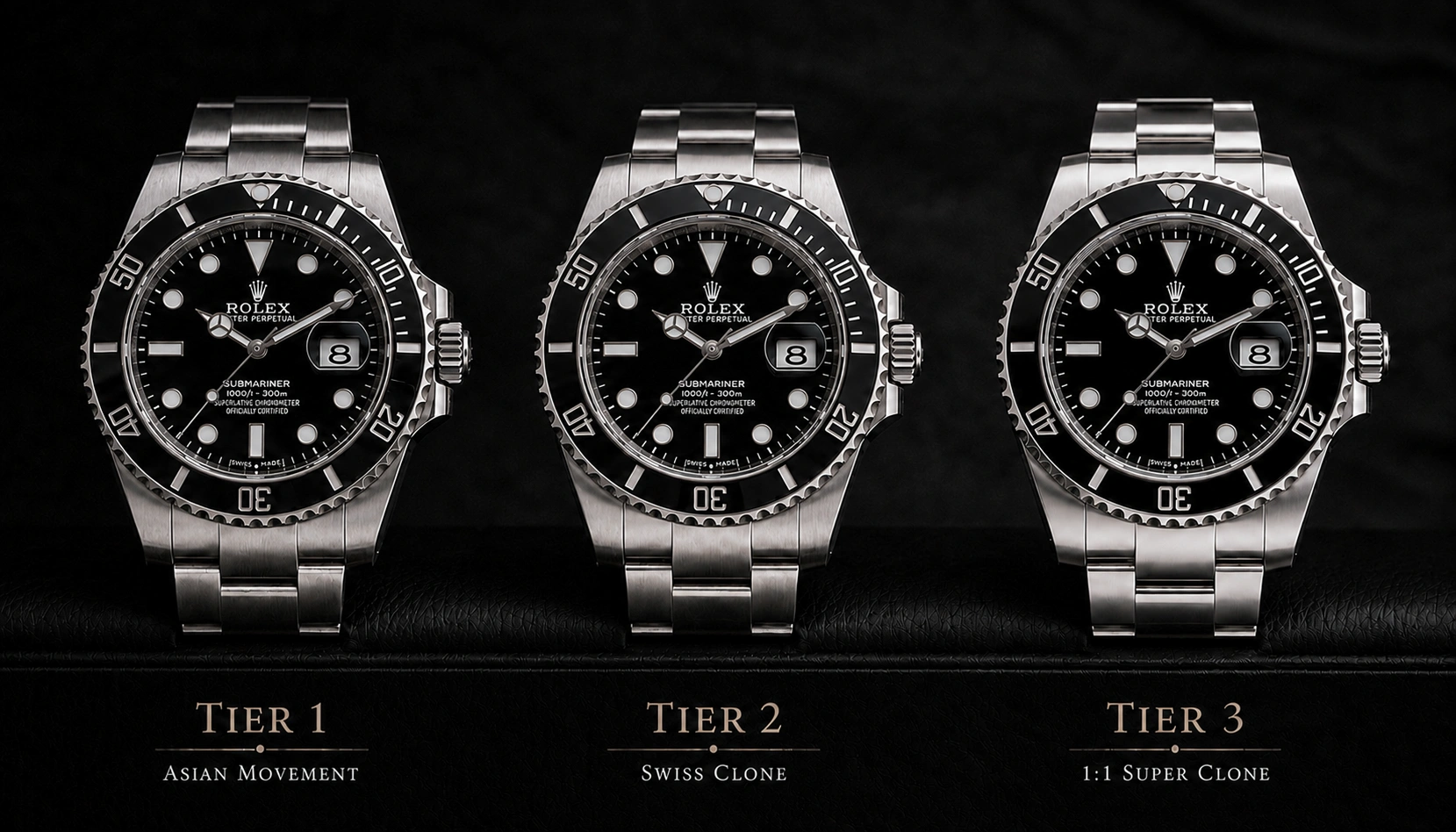
Core Comparison: See the Differences at a Glance
The table below consolidates the six most critical hard specs. Just read this table to judge what level a watch is at.
| Parameter | Asian Movement Version | Swiss Movement Version | 1:1 Clone Version |
|---|---|---|---|
| Case Metallurgy | Standard 316L Stainless Steel | 317L High-Moly Steel (Trade "904") | High-Purity 904L Superalloy |
| Crystal & Coating | Basic Synthetic Sapphire (Uncoated / Blue AR) | Optical Synthetic Sapphire (Colorless AR) | Optical Synthetic Sapphire (Colorless AR) |
| Movement Architecture | 2813-Grade Platform (21,600 vph) | 2824 / 2836 High-Beat Platform (28,800 vph) | Dandong Integrated Custom Caliber |
| Chronograph Subdials | Static / Cosmetic Only | Static / Pseudo-Date Mod Only | Fully Functional Mechanical Registers |
| Regulation & Daily Rate | ±15 to 30 s/day | ±8 to 15 s/day | ±3 to 5 s/day (Fine Regulated) |
| Case Finishing | Stamped, Minimal Edge Beveling | Machine-Brushed, Basic Mirror Polish | CNC Micro-Beveled, Hand-Polished Lustre |
Additional Comparison: Power Reserve, Water Resistance, Lume, Lifespan, and Factory Source.
| Item | Asian Movement Version | Swiss Movement Version | 1:1 Clone Version |
|---|---|---|---|
| Power Reserve | 24–36 hours | 40–48 hours | 70+ hours |
| Water Resistance | Splash Resistant Only | 3–5 ATM | 10 ATM |
| Lume | Approx. 1–2 hours | Approx. 4–6 hours | 8+ hours |
| Cyclops Magnification | Approx. 1.8×–2.0× | Approx. 2.3×–2.5× | Approx. 2.5× with AR |
| Serviceability | Usually Not Economical | Often Serviceable | Serviceable by Specialist |
| Typical Lifespan | 1–3 years | 5–8 years | 10+ years |
| Factory Source | Various / Unknown | Mid-Tier Factories | VSF, CF, APS, BT, etc. |
Asian Movement Version: 2813-Grade Platform, Budget First
Lowest entry, basic appearance. Core compromises in movement, steel, crystal optics, and complications.
Key Features
Who Should Buy
- First-time buyers, budget-first
- Occasional wear, no water contact
- Low demands on accuracy, finishing, complications
Swiss Movement Version: 2824 / 2836 High-Beat, Best Value
Comprehensive upgrade in appearance, movement, materials, and crystal. The most balanced tier for daily wear.
Key Features
Who Should Buy
- Daily wear, seeking stability
- Want a serviceable movement with adjustable accuracy
- Want near-high-end look and feel on a moderate budget
1:1 Clone Version: Dandong Integrated Custom Caliber, Ultimate Replication
Movement, steel, crystal, finishing, and complications all aim for high-end. A collector-grade choice.
Key Features
Who Should Buy
- Collector-level, pursuing maximum replication
- Value movement architecture, materials, and complications
- Understand factory, version, and batch differences
Technical Differences: Metallurgy, Crystal, Complications
If you want to see "why they differ," the three key differences below matter most. Condensed into bullet points.
1. Metallurgy: 316L vs 317L vs 904L
- Asian Movement Version — 316L: Conventional austenitic stainless steel. Enough for daily rust resistance, but stamping marks are visible and edges are sharper.
- Swiss Movement Version — 317L: 3%–4% molybdenum, higher nickel, better chemical resistance, cooler and brighter polish. Often called "904" in supply chains.
- 1:1 Clone Version — 904L: High-purity superalloy with copper, chromium, nickel. Resistant to chlorides and acids. Accepts high-density diamond lapping. Weight, refraction, and oily lustre close to genuine.
2. Crystal: Basic Sapphire vs Optical Sapphire
- Asian Movement: Flat or single-domed sapphire, minimal edge radiusing. Most have no AR or only single-layer blue film. Milky and heavy glare under strong light.
- Swiss Movement / 1:1 Clone: Optical-grade synthetic sapphire, CNC diamond cut, matching genuine bezel seat height. Multi-layer colorless double-sided AR, >98% light transmission. No whiteout, no glare. Dial typography clear and transparent.
3. Complications: Decorative Subdials vs Fully Functional Registers
- Asian Movement / Swiss Movement: Three-register chronographs mostly based on 2813 or 2824 three-hand movements. Subdials are decorative only. Hands pinned or linked only to calendar. Pushers do not drive a chronograph clutch.
- 1:1 Clone: Uses native integrated custom calibers such as the 4130, 4131, 3285, 3255, 324, 330, and other brand-specific movements. The gear train, column wheel, and vertical clutch are all integrated into the base plate. All three subdials operate for real. Button feel, reset alignment, and daily rate of ±3–5 s/day all reach a high level.
QC Checklist: 6 Key Checks Before Accepting
Even the same factory and version can vary. The six checks below cover most issues.
Dial
- Logo and text centered
- No dust, fibers, or marks
- Date window centered
Hands
- Hands do not touch each other or the crystal
- Edges clean, no burrs
- Seconds hand runs smoothly
Bezel
- Smooth rotation, consistent resistance
- 12 o'clock alignment
- No bubbles, chips, or uneven fill
Bracelet
- Minimal end-link gaps
- Clasp opens and closes smoothly
- Links articulate without binding
Movement
- Runs consistently
- Date changes correctly at midnight
- Winding feels smooth
Case and Crystal
- No scratches, dents, or sharp edges
- Crystal seated evenly
- Cyclops straight and properly positioned
FAQ (Condensed)
1. What is the difference between 316L, 317L, and 904L?
316L is the standard steel for Asian Movement; 317L has higher molybdenum and nickel, better corrosion resistance, cooler and brighter polish, commonly used in Swiss Movement; 904L is a high-purity superalloy, resistant to chlorides and acids, closest to genuine in weight and lustre, used only in 1:1 Clone.
2. Why do the chronograph subdials work on the 1:1 Clone?
Because it uses a Dandong integrated custom caliber with gear train, column wheel, and clutch all natively integrated; Asian Movement / Swiss Movement mostly use three-hand movements with decorative modules, so subdials are just for show.
3. The crystals look similar—why the big price difference?
Asian Movement often has no AR or blue AR, milky under strong light; Swiss Movement and 1:1 Clone use optical sapphire with colorless multi-layer AR, >98% light transmission, no glare, clearer dial.
4. Which tier is worth buying?
Budget-first choose Asian Movement; daily wear and value choose Swiss Movement; collecting, complications, and ultimate replication choose 1:1 Clone.
5. Can I trust the water resistance rating?
Do not rely on the rating alone. Asian Movement is splash resistant only; Swiss Movement rated 3–5 ATM; 1:1 Clone rated 10 ATM. Any tier should be individually pressure tested before water contact.
6. What about lifespan and servicing?
Asian Movement approx. 1–3 years, usually movement replacement rather than repair; Swiss Movement approx. 5–8 years, adjustable and serviceable; 1:1 Clone 10+ years, serviceable by specialists.
7. Do VSF, CF, APS, BT matter?
Yes, but do not rely on the factory name alone. Different versions from the same factory vary greatly. Judge by specific model, movement, materials, batch, and QC photos.
8. Can it fool a watchmaker?
In photos it may be hard to tell, but a professional watchmaker can identify it after opening the case and examining the movement, finishing, and materials. The point of a replica is the wearing experience, not deceiving authentication.